Posts

Showing posts with the label s1e1

The actual Good Place
Image
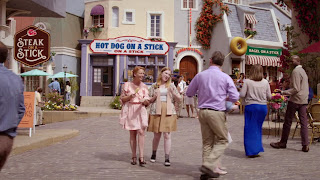
Michael: The Good Place is divided into distinct neighborhoods. Each one contains exactly 322 people who have been perfectly selected to blend together into a blissful harmonic balance. Eleanor: Do all the neighborhoods look like this? Michael: No, every neighborhood is unique. Some have warm weather, some cold. Some are cities, some farmland. But in each one, every blade of grass, every ladybug, every detail has been precisely designed and calibrated for its residents. Eleanor: There’s a lot of frozen yogurt places. Michael: Yeah. That’s the one thing we put in all the neighborhoods. People love frozen yogurt. I don’t know what to tell you. (Season 1, episode 1) People have all kinds of ideas about heaven. One idea is that heaven is perfectly tailored to each individual, and is a place where your every desire is fulfilled for eternity. In other words, the fantasy of a two year old: whatever you want, whenever you want it. Another image is that heaven...

Why judge at all?

Image
Michael: You know how some people pull into the breakdown lane when there’s traffic, and they think to themselves, “Ah, who cares? No one’s watching.” We were watching. Surprise! (Season 1, episode 1) Eleanor: I just want to say once more, for the record, that this whole good/bad system is bullshirt. (Season 1, episode 8) Why should there be a judgement anyway? This hasn’t really been explained in The Good Place (as of season 3), but reading between the lines, the idea may be that there is justice and fairness in the universe, and what you do on earth matters. (Though as Michael has discovered, the system has some major problems). There are two kinds of final judgement according to the Bible: one for people who have accepted God’s forgiveness, and one for people who have not. These two judgements are about very different things. For the second group, the central idea is justice; it will be clear to everyone that God’s judgement is...

What is good anyway? (part 1)

Image
Michael: So, Chidi, just want to double check. How do ethical philosophers feel about murder? Chidi: It’s frowned upon. Michael: OK. What if the reason you want to murder someone is to make your life easier? That’s OK, right? (Series 2, episode 7) The characters in The Good Place struggle to identify what makes a particular action “good.” They are initially told that this can be precisely determined (to two decimal places): Michael: During your time on Earth, every one of your actions had a positive or a negative value, depending on how much good or bad that action put into the universe. Every sandwich you ate, every time you bought a magazine, every single thing you did had an effect that rippled out over time and ultimately created some amount of good or bad. (Series 1, episode 1) Which is quite similar to Utilitarianism, where the sum total of positive and negative effects is what matters: Chidi: Utilitarianism posits that the correct ch...

The point system

Image
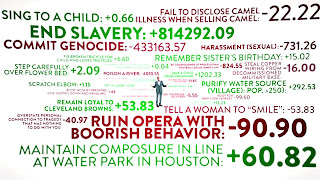
Did you know: Remembering your sister’s birthday gets you 15.02 points towards entry into the Good Place? Ruining an opera could make you lose 90.9 points? Genocide costs 433163.57 points, but ending slavery gains you 814292.09 points? Selling a camel without disclosing its illness costs 22.22 points? (Episode 1, Season 1). The premise of The Good Place is that people’s place in heaven is earned: their good and bad deeds over a lifetime are painstakingly weighed up (by immortal accountants), and a high enough total gains them a pass mark. This idea has a few different consequences: ☛ People who are aware of (or suspect the existence of) the point system can get stressed about missing out by a few points; if they do something wrong, particularly just before they die, it might be enough to tip the balance and forbid them entry to the Good Place. Having your eternal fate depend on how good you are at “being good” is very anxiety inducing. (Th...